Training analytics · Australian racing
The stable analyst you always wanted, without the salary.
You already collect the data. CarrotTracker organises it into a profile for every horse, tracks it session by session, and reports back in plain English.
- Every horse gets its own profile. Every session you've recorded sits in one place, read against that horse's own normal.
- Ask the stable. Put a plain-English question about your own horses and get the answer from your own data.
- Collected, organised, tracked and reported for you. It arrives on its own, with nothing to upload and no spreadsheets, for far less than an analyst or a consultant.
Two weeks free on your own horses. No card, no contract.
Or call Kyle on 0411 559 840
The product
Your data, organised
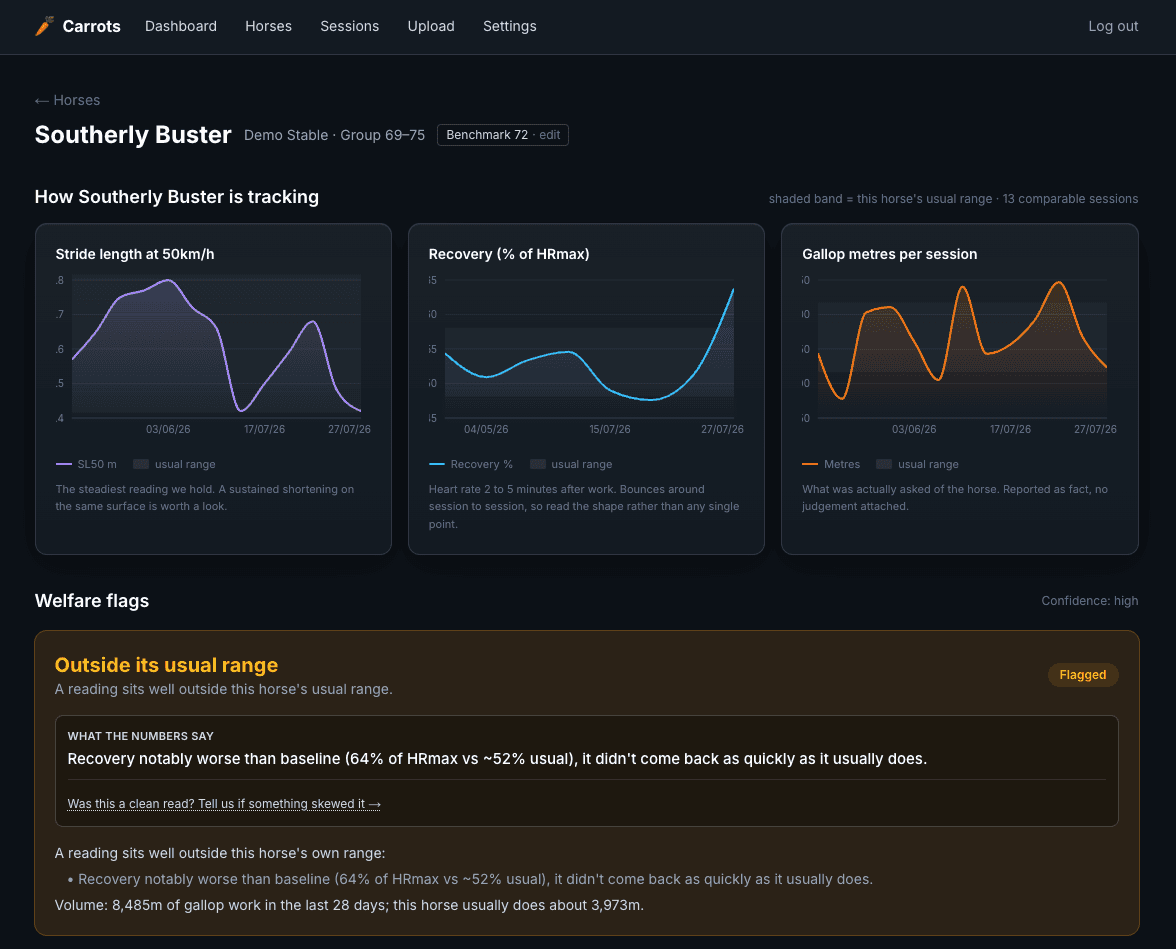
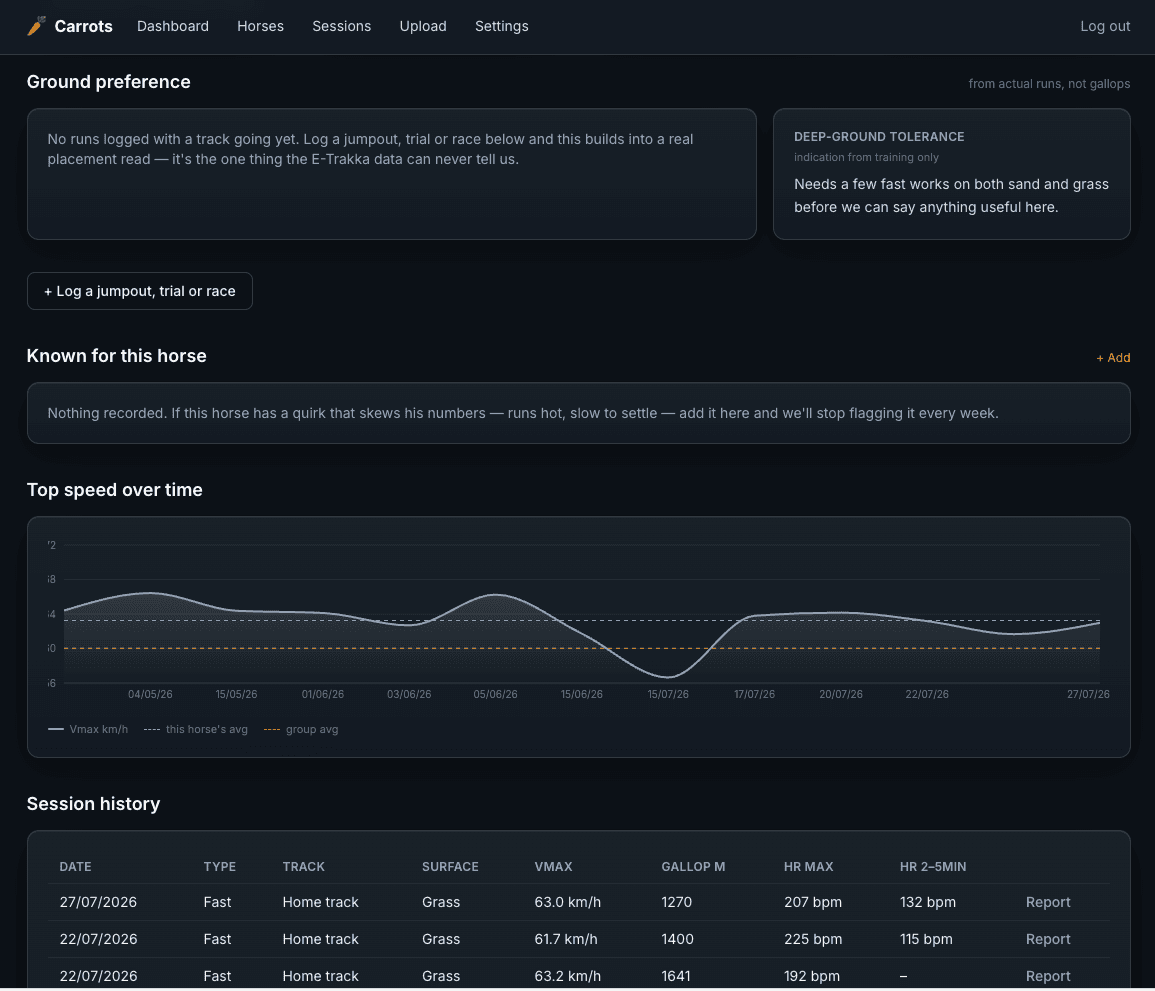
Every horse, every session, the whole history in one place. Trends drawn for you, each gallop set against that horse's usual range, and a plain-English line on top telling you what actually moved. All of it is there when you want it. You just do not have to go looking to find the one horse that is off.
- Every session you have ever recorded, kept and searchable
- Trends drawn automatically: speed, recovery, stride, workload
- Written for a trainer, not an analyst
- Every figure traceable back to the raw session
Sectional times
The times you already get, finally worth something
Your timing system records every 200m of every gallop and then shows you a single row of numbers with nothing behind it. The times were never the problem. We put them in context and give you a picture you can read in one look.
- Every gallop drawn the way the horse ran it, top of the run through to the line
- The last one, two, three or five pieces laid over each other
- That horse's usual range shaded behind, so you can see what is normal for it
- The sectional times spelled out underneath, because that is what you came for
Whether a horse quickened to the line or dropped away is the first thing you want to know, and it takes one look.
What it does
Built for the stable, not the lab
Every session you collect becomes a profile for that horse. Each morning you get a read on how its numbers sat against its own usual range.
Nothing to upload, no jargon, and quick to check. It arrives before you do.
All of it, in one place
Your GPS and heart-rate data lands automatically and joins everything that came before it. Speed, workload, recovery, stride, sectionals, race results. One horse, one page, the whole history, instead of a folder of exports nobody opens.
- No spreadsheets
- No sports scientist
- Nothing to upload
Against itself, first
CarrotTracker learns each horse's usual range and tells you when a reading sits outside it. Every horse is read against its own normal, not against somebody else's.
- Per-horse usual range
- Read against its own normal
- Sharpens with every gallop
Everything there, nothing shouting
Every session and every metric is there to dig into whenever you want. What stays quiet is the alarm: flags are held back for readings that genuinely sit outside a horse's usual range, so when something is raised it is worth your attention.
- Thresholds set against real sessions
- Deviations surfaced first
- You can mark a bad read
Pricing
Try it for two weeks. Then decide.
We set it up on your own horses and you use it properly for a fortnight. No card, no contract, nothing to cancel. If it is not telling you anything you did not already know, that is a fair answer and we part on good terms.
After that it is one price for the stable, not per head. We work it out around the size of your operation so it is worth having. Ask and we'll tell you the number straight. No quoting process, no salesperson.
Any size stable
Four horses or forty. We would rather tailor something that works for a small yard than price you out of it, so get in touch whatever your setup looks like.
Every horse included
The tried ones and the ones you are still making your mind up about. Per-head pricing quietly pushes you to only track the good ones, which is the opposite of useful.
Leave whenever
Monthly, no lock-in, no minimum term. No setup fee, because we connect it to the timing gear you already have.
Evidence
An instrument, not a coach.
CarrotTracker will never tell you to ease a horse up, step it up, or hold it where it is. It reports what the numbers did and stops. Training is your craft. This is a better gauge on the dashboard, not a hand on the wheel.
Thresholds set on real data
Tuned so flags stay rare
Thresholds were set by running them over every session we hold and tuning until flags fired on roughly three in a hundred, which is rare enough to be worth reading. Every metric was tested for whether it carries information from one session to the next. The ones that turned out to be noise were quietened, not dressed up.
Tested in working stables
Six stables, on real gear
It has been through real mornings on real horses that were actually racing, not just a spreadsheet. Riders, gear slipping, horses playing up, wet tracks. All of it.
Deviations, not diagnoses
Flags mean look, not act
A flag means a reading sat outside that horse's usual range and is worth your eyes on the horse. It is not a diagnosis and never claims to be one. A quiet app on a normal day is the whole point. False alarms are what make trainers stop reading.
Your data
It is yours, and no other stable sees it.
Your sessions belong to your stable. Access is isolated in the database itself, not by a permission setting somebody could get wrong. A query run as your stable physically cannot return another stable's horses.
We do not sell data, and we do not share it with bookmakers, form services, media or anyone else. If you leave, your data goes with you and we delete our copy on request.
How it works
Set up once. Then it just arrives.
- 1
Connect once
We link to the timing system you already use. Nothing changes about how your riders work or how the gear goes on.
- 2
It runs itself
Sessions import automatically three times a day, get matched to the right horse, and are checked for bad reads before anything is shown to you.
- 3
You read the stable
Open it on your phone. The horses that moved off their usual range are at the top. Everything else says 'as expected' and stays out of your way.
I built CarrotTracker because the data stables already collect was being thrown away. I set it up personally with every stable that comes on, and you deal with me directly.
Kyle Ryan · Founder · kyle@carrottracker.com
Straight answers
Do I pay per horse?
No. One price for the stable, and every horse you work is included. The tried ones, and the ones you are still making up your mind about. Per-head pricing quietly encourages you to only track the good ones, which defeats the point of knowing what is usual for each horse.
Is my stable too small for this?
No. We would rather build something that works for a four-horse yard than price you out of it, and the read on an individual horse is exactly the same whether you have four or forty. Get in touch and we will work out something that is worth having.
What does the free trial involve?
Two weeks on your own horses. We connect it to the gear you already have, load your history so there is something to compare against from day one, and you use it properly. No card up front, nothing to cancel, and we do not keep your data if you decide against it.
Does it tell me how to train my horse?
No, and it never will. CarrotTracker reports what the numbers did against that horse's usual range and stops there. The training call is yours. We built it as an instrument, not a coach, because the evidence does not support anything stronger.
Who owns my data, and do you pool it?
The session data is yours. No other stable can see your horses. Accounts are isolated at the database level, not by a setting somebody could get wrong. We do not pool your horses with anyone else's.
Do I have to change my gear?
No. It reads the data your existing system already collects, so it sits on top of what you have rather than replacing it.
What happens when a reading is rubbish?
Gear slips, horses get fired up, riders take a different route. You can mark a session as not a clean read, or record a permanent trait for a horse, and CarrotTracker stops counting it against them.
You read 17 metrics but the report only mentions a few. Why?
Because most of them should stay quiet. We tested every metric for whether it actually carries information from one session to the next, and the ones that turned out to be noise were quietened down rather than dressed up. A report that mentioned all seventeen every morning would be a data dump, which is the thing you already have.
See it on your own horses.Free for two weeks.
Whatever size your stable is and whatever gear you are on, get in touch. We will set it up on your own horses and you can make your own mind up over a fortnight. No card, no contract.
Or email kyle@carrottracker.com. Already set up? Log in to your stable.